Why does the belt mistrack at higher throughput?
The same conveyor belt may run steadily when empty or at low throughput, but once production increases, material flow fluctuates more, or frequent starts and stops occur, the belt may begin drifting to one side. This is a common issue in belt conveyor systems.
Simply put, normal operation at low throughput does not guarantee the same stability at higher throughput. As the amount of material increases, lateral forces caused by material loading, material weight, belt support conditions, and belt tension can all change. Small loading or structural deviations that were previously difficult to notice may become more pronounced.
When this happens, it is useful to focus on one question: what changes in the system as throughput increases? Comparing these operating conditions often gets closer to the actual cause than checking only the belt centerline while the conveyor is stopped.
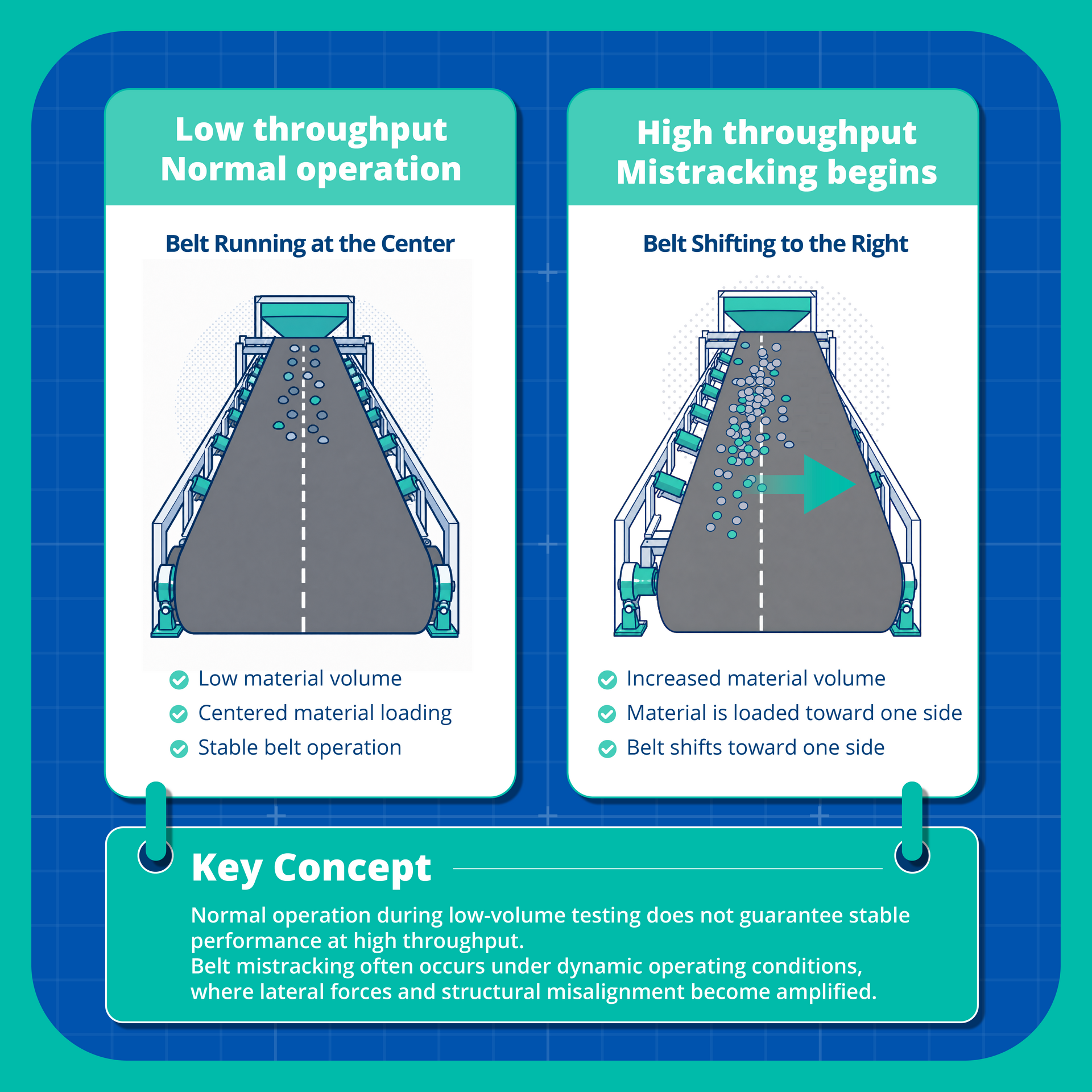
Q: Why does the belt start mistracking when throughput increases?
1. Off-center material loading creates a continuous lateral force on the belt
If material does not land near the center of the belt and instead falls toward one side, it creates an off-center load.
At low throughput, the amount of material may be too small for this lateral force to noticeably affect the belt path. As throughput increases, the same loading deviation produces a greater imbalance, making the belt more likely to drift gradually toward one side.
During inspection, compare the material loading position under different throughput levels. Check whether the material still lands close to the belt center, and whether the flow direction changes as production increases.
2. Uneven material distribution creates different loading conditions on each side
Even when the loading point appears close to the center, the material may not be distributed evenly across the belt.
If material accumulates more heavily on the left or right side, the two sides of the belt are subjected to different loading conditions. As throughput increases, the weight concentrated on one side also increases, and a minor imbalance may begin to affect belt tracking.
In addition to checking where the material lands, it is also important to observe how the material spreads after landing on the belt. For mistracking that occurs only during higher production rates, the material profile and side-to-side distribution are particularly useful indicators.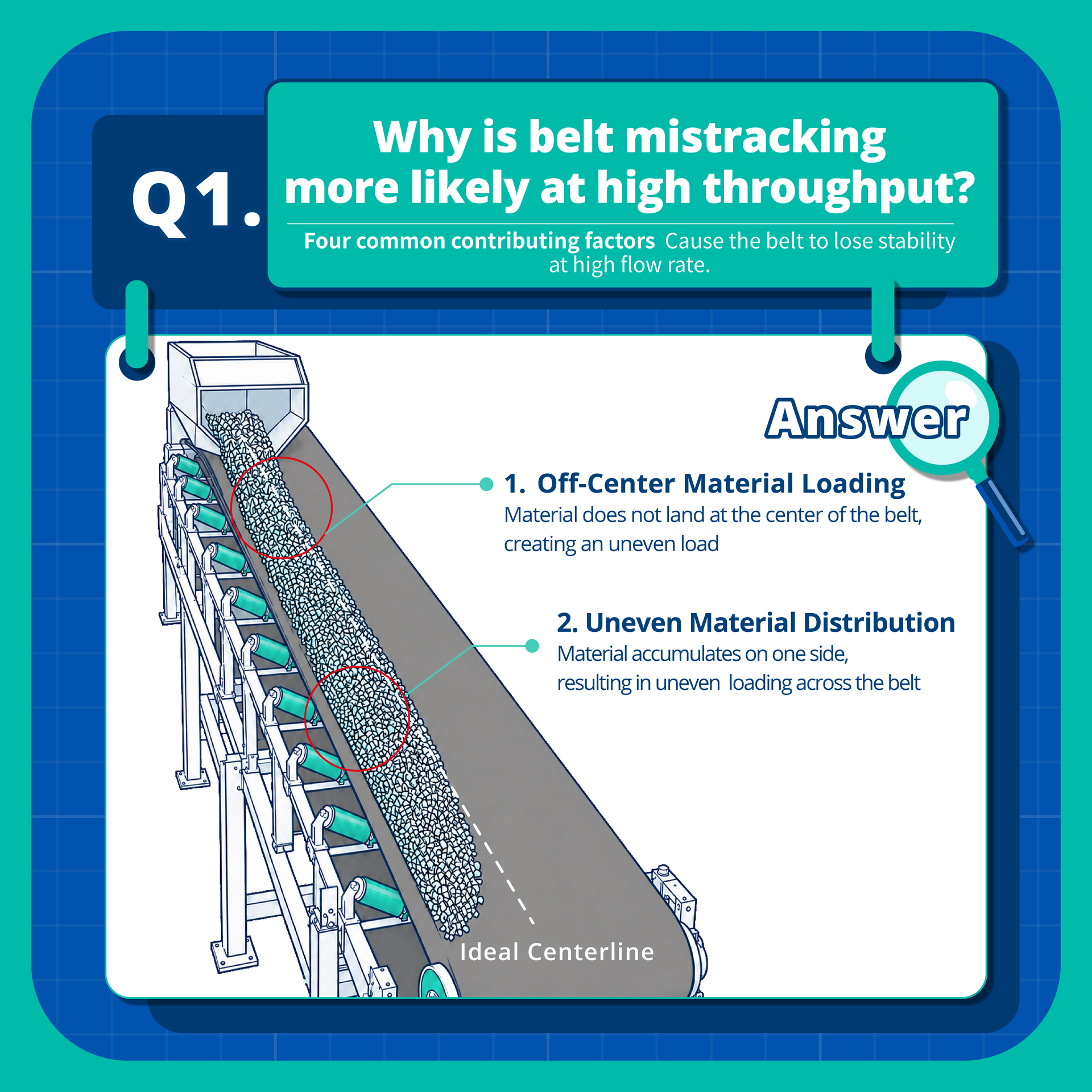
3. Support conditions in the loading zone change as material volume increases
The loading zone is exposed to material impact and is also an area where changes in belt support conditions can become more noticeable.
Belt sag itself mainly affects sealing and spillage. However, if the same area also has seized rollers, material buildup on rollers, uneven support between the two sides, or structural deflection under load, these conditions may further affect the direction of belt travel.
Some conveyors show no obvious problems at low throughput because the support system has not yet been subjected to greater loading. As production increases, structural loading changes, and small differences that were previously hidden may begin to appear as belt mistracking.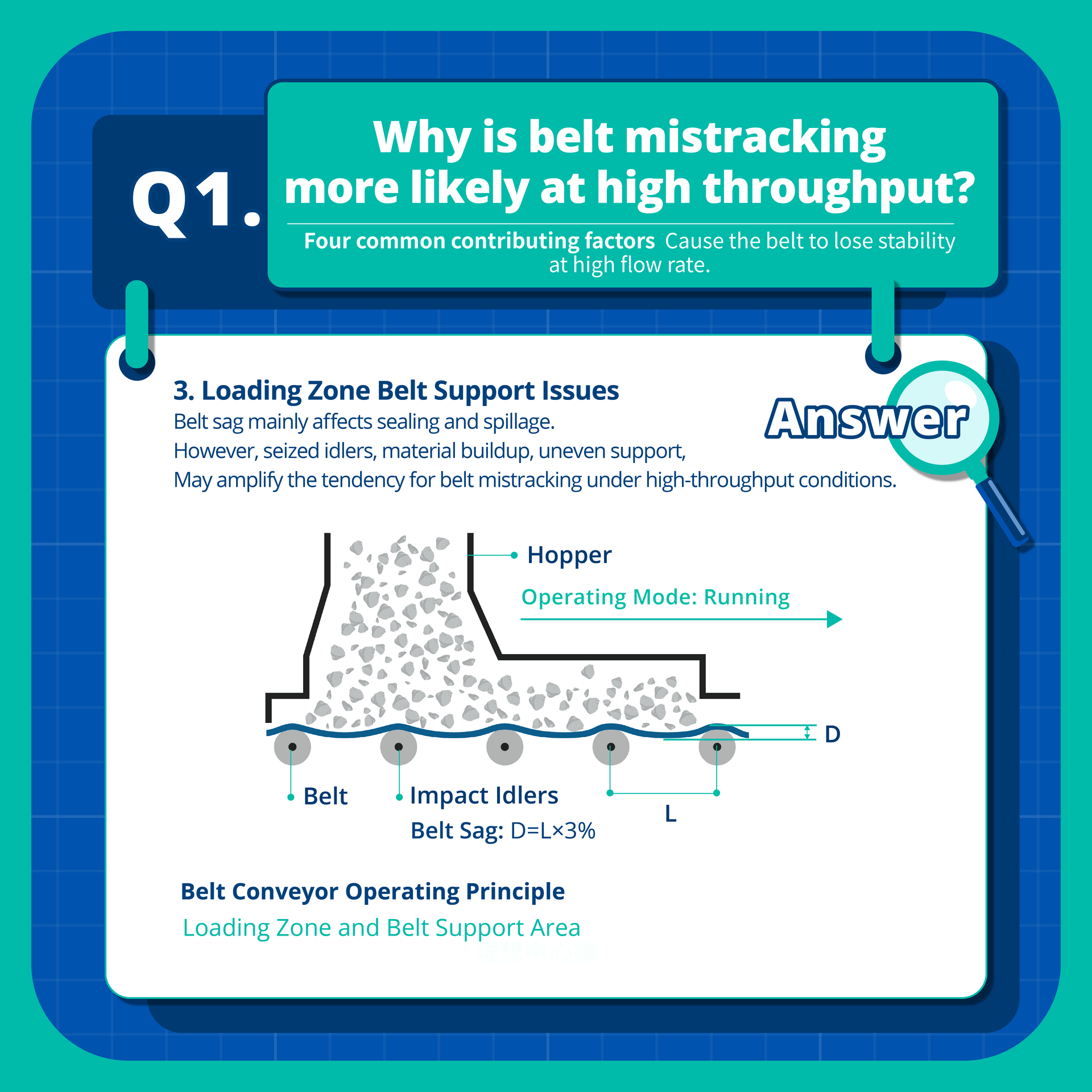
4. Small deviations in conveyor geometry and the take-up system become more significant
If idler sets, pulleys, or the take-up system are slightly misaligned, the effect may not be obvious during low-throughput operation.
As throughput increases or the conveyor starts and stops frequently, belt tension changes with the operating conditions. Small geometric deviations, combined with changes in belt tension and force distribution, can further affect the belt’s running direction.
The response of the take-up system should also be checked. If belt tension cannot remain within an appropriate range as operating conditions change, or if the forces on the two sides become uneven, mistracking may become more noticeable at higher throughput.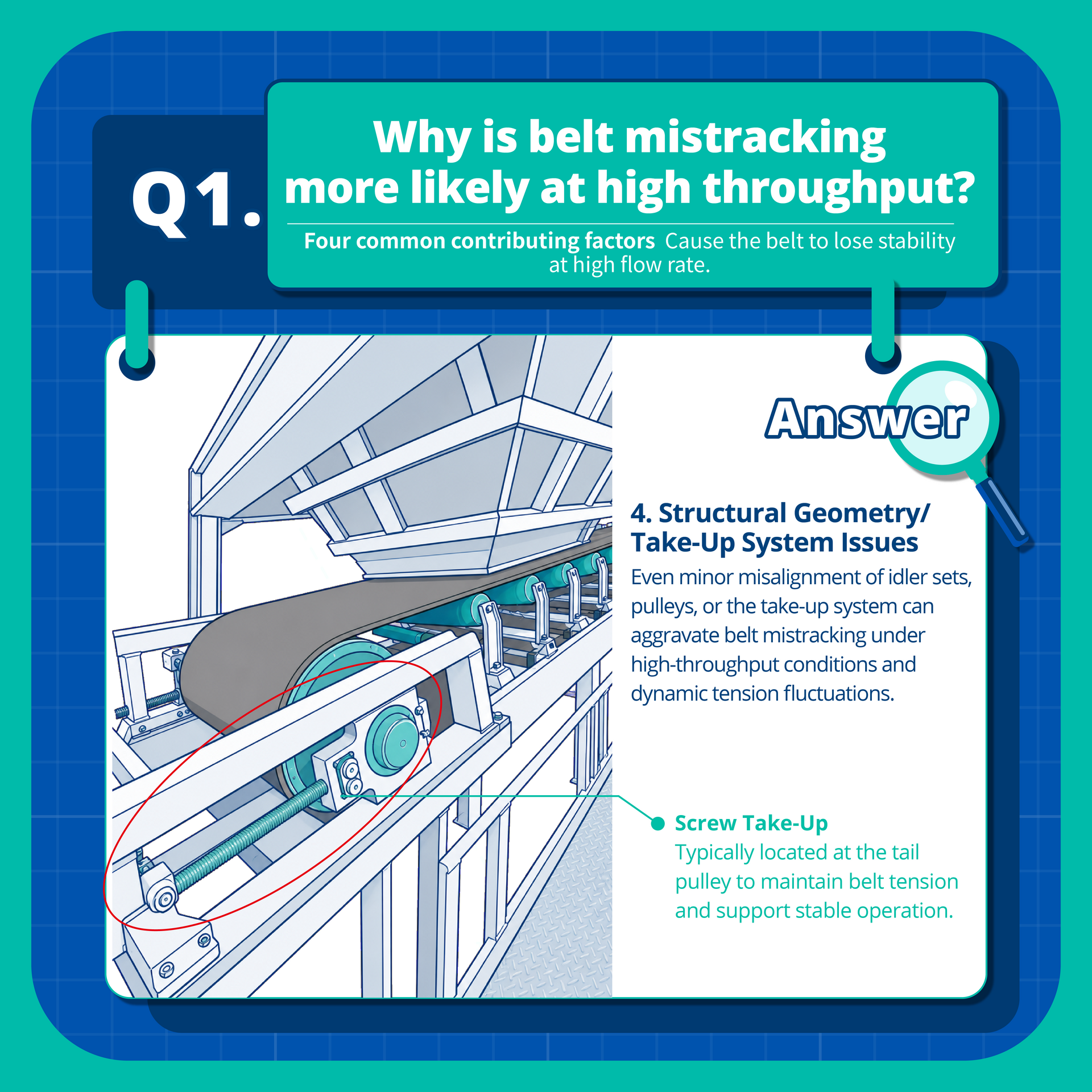
Q: If the belt starts mistracking, what should be checked?
For this type of issue, it is better to compare the conveyor under different actual operating conditions rather than relying only on static alignment checks after shutdown. The following four areas can be checked step by step:
Step 1. Compare Loading Positions Across Throughput Levels
Observe whether the material continues to land near the center of the belt as production increases.
Step 2. Check how the material is distributed across the belt
Confirm whether the material is concentrated on one side, creating different loading conditions between the left and right sides.
Step 3. Measure belt sag and support conditions
Check roller operation, material buildup, left-right support conditions, and any changes in the structure under load.
Step 4. Verify take-up response and tension changes
Compare belt tension under different throughput levels or during start-stop operation and look for noticeable changes.
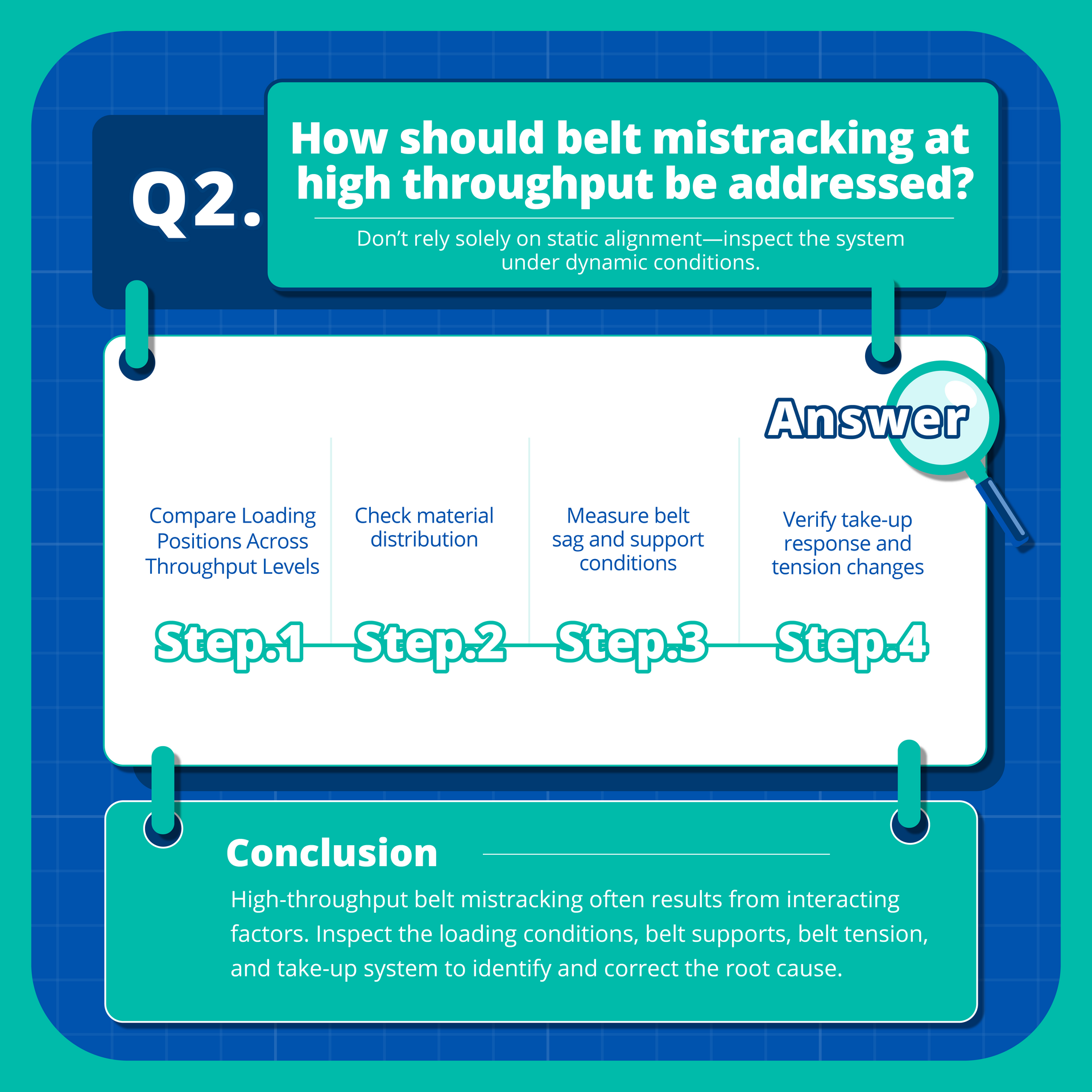
If site conditions allow, it is also helpful to record at what throughput the mistracking begins, which direction the belt moves toward, and whether it occurs during steady conveying or during starts and stops. Reviewing this information together with loading, support, and tension conditions can make it easier to identify the relationship between belt mistracking and operating conditions.
Normal operation at low throughput does not eliminate the need to check actual conditions at higher throughput
If belt mistracking occurs only when throughput increases, the cause is often related to dynamic operating conditions. Material loading position, material distribution, belt support, conveyor geometry, and belt tension may all affect tracking at the same time. Looking at only one factor can easily overlook the actual source of the problem.
A practical approach is to compare what changes between lower and higher throughput conditions and identify which factor begins to shift as production increases. Once the cause is identified, adjustments can then be made to the loading, support, or take-up system. This is more effective than repeatedly correcting the belt position and can help maintain stable operation across different throughput levels.